Melange
Where creative people find their next collaboration. Photographers, models, stylists and other creatives find each other nearby, see who's into their work, and make something together. The hard question is who to show you, so an AI learns taste from the work people make, and its suggestions are checked against random ones.
- What I proposed
- An app for creative people to find collaborators, with an AI that learns taste from the work people make and suggests who to work with, measured against random suggestions.
- What it produced
- Live on the App Store (2.1) and the web. The table composer beats random seating on its own taste objective (0.77–0.85 vs 0.64–0.69), so the optimizer works; whether it produces more real collaborations is what the first events will measure. About a dozen accounts so far.
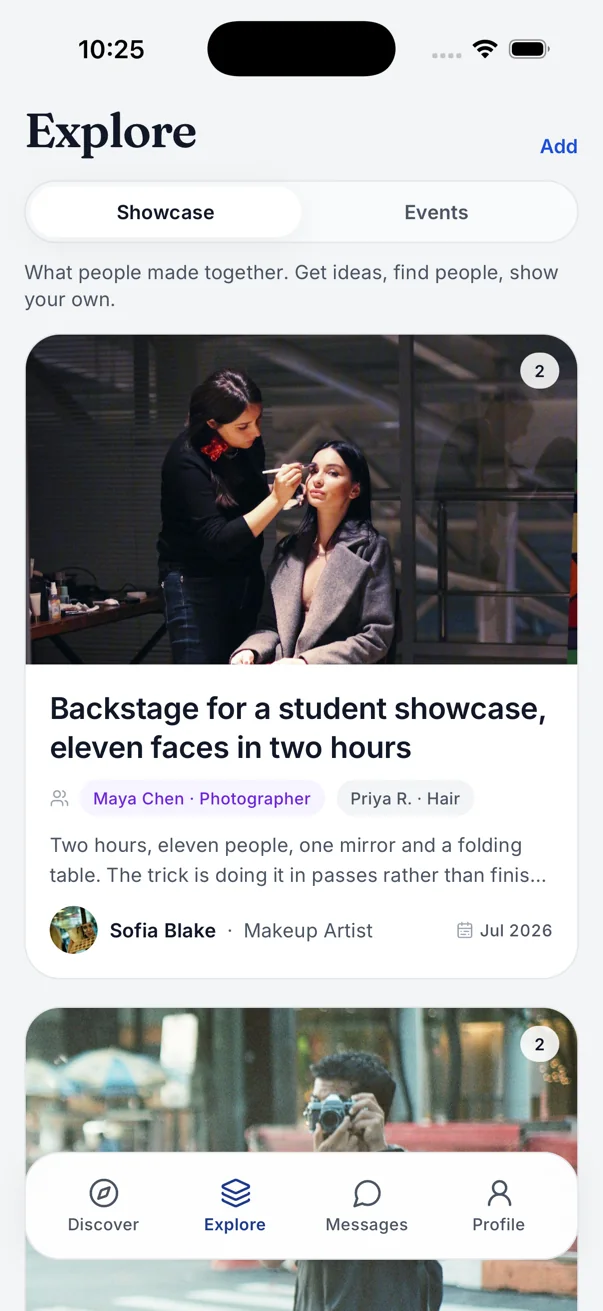
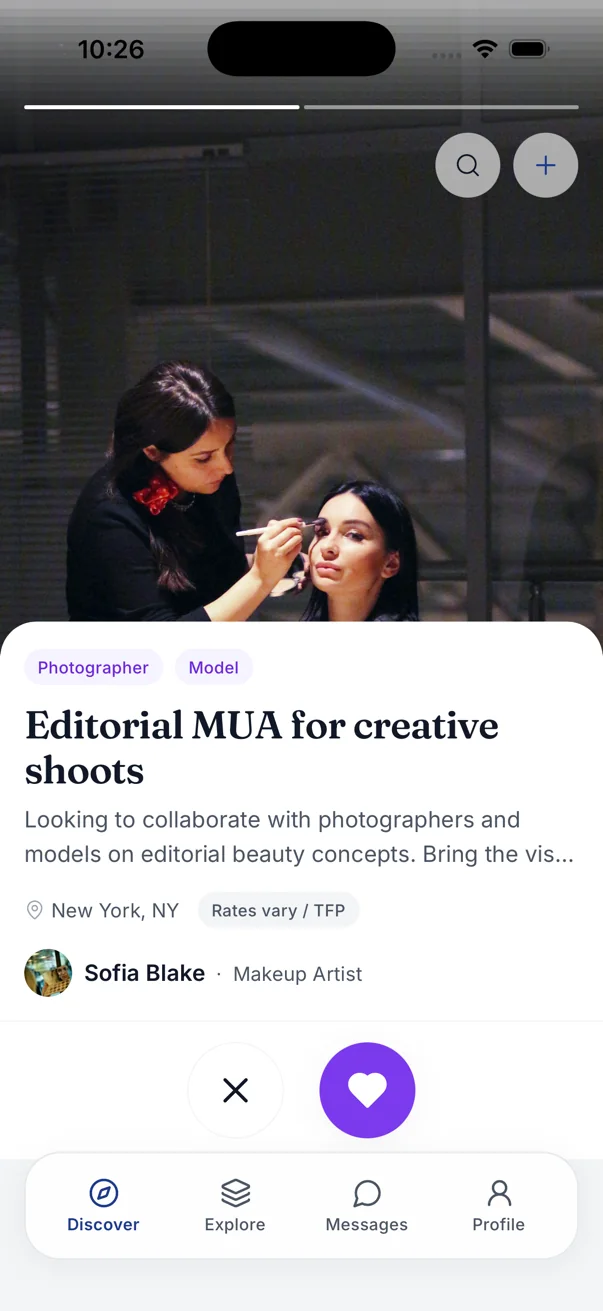
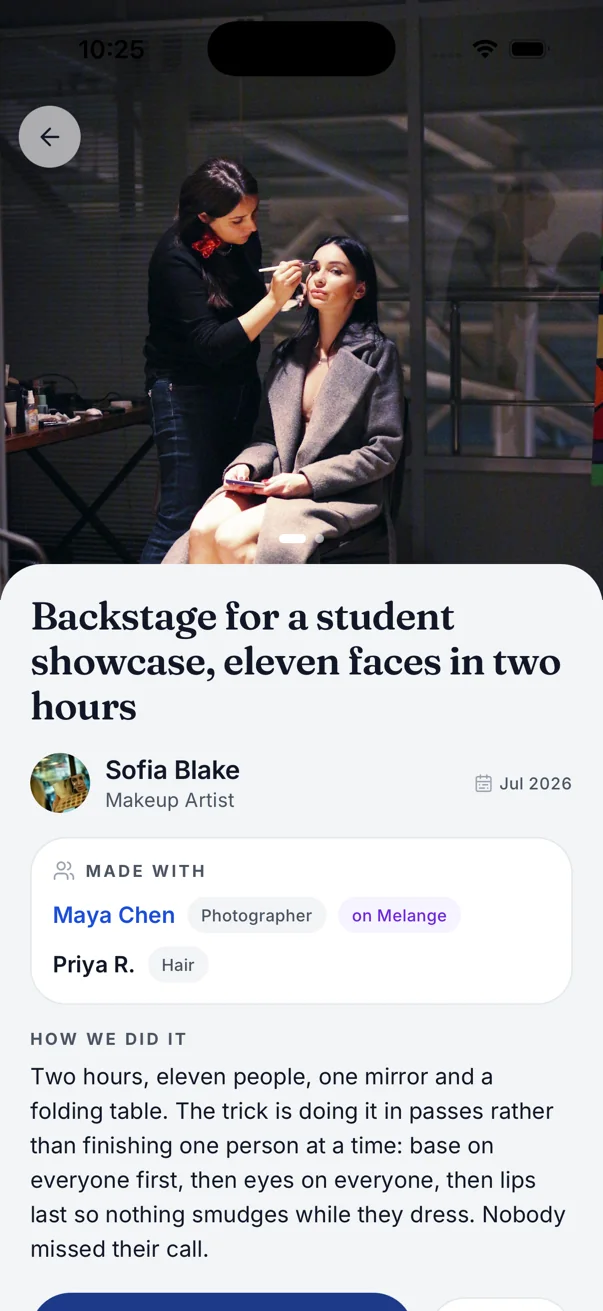
The shipped iOS app: Explore, Discover, and a shoot with everyone on it credited.
What it does
Discover is the front door: swipe through creatives and projects near you, heart the work you like, and when it's mutual a conversation opens. Around that sit the things a collaboration needs: events where people meet in person, with a group chat and a private photo roll for the people who went, and credits that record who made what.
Some of that came from research. I studied about fifty consumer social companies from 2023 to 2026; the ones that lasted gave people a reason to come back in real life and kept content of you and your friends private. Events and private photos are Melange's version of that.
Who you should work with
Taste. Each member's taste is the average CLIP embedding of the images they've posted and hearted. The model is open-source and runs as a batch job on a laptop GPU, so no member's photos go to a third party, and it never sees a question about anyone's looks, only what they make and like.
Pairs. A pair score combines taste similarity, whether two roles make each other's work possible (a photographer and a stylist, not two photographers), and shared interests. The weights start as a prior and will be refit from what happens: whether two people hearted each other afterwards.
Groups. At an event, a composer uses the score to seat whole tables rather than match pairs. Its objective is each person's average chemistry with their tablemates passed through a concave curve, so lifting the person who's worst off counts for more than making a good table slightly better. Blocked pairs are never seated together. It's a local search (random starts and swaps) that finishes in milliseconds at this size.
The test. The AI is checked against random choices instead of being assumed to help. At an event, attendees are split at random: half seated by the composer, half at random, with nobody told which half they're in. Afterwards the halves are compared on mutual hearts, conversations still going a week later, and coming back.
The first production run caught a flaw in my own design. With thirteen people, each half got exactly one table, so the composer had no choice to make, and its “AI” table scored worse than the random one. Tables now shrink until each half has at least two. After the fix, the AI's groups beat random on every run.
Privacy the database enforces
Both apps talk straight to Postgres with a public key, so every rule has to live in the database. After an event you can privately heart anyone who was there; you only find out if it was mutual. Those hearts sit in a table with row-level security on and no read policy at all. The only way in is a function that answers when a heart is mutual. My first design reused the app's general hearts table, which notifies on every insert, and would have told everyone about every one-way heart.
An event's photos live in a private bucket whose read rule derives membership from the file's path, so they're visible only to the host and the people who went.
Testing against production without changing it
Every migration since October runs first inside BEGIN … ROLLBACK against the live database, with tests that impersonate real roles: can an outsider read an event's chat, does a forged upload path get through, does a second invite code get refused. Nothing persists, and the checks run on real data instead of a fixture.
That caught a policy someone had added in the dashboard (present in production, in no migration) that let signed-out visitors read every profile. The schema in the repo and the database had drifted apart, and nothing else would have said so.
Discover is a query
Discover's feed is ranked by one Postgres function: eight weighted terms plus a small boost for verified authors, no service to call. The taste score is blended on top: it nudges the order of projects and leads the order of people, so the creatives whose work is closest to yours come first.
Where it stands
Live on the App Store (2.1) and the web. About a dozen accounts, so this is a working product and not yet a traction story. The taste model, the composer and the experiment are deployed; the first measured result comes from the first real events.